 Bright Solution
 Property Laws and Regulations
 January 14, 2025
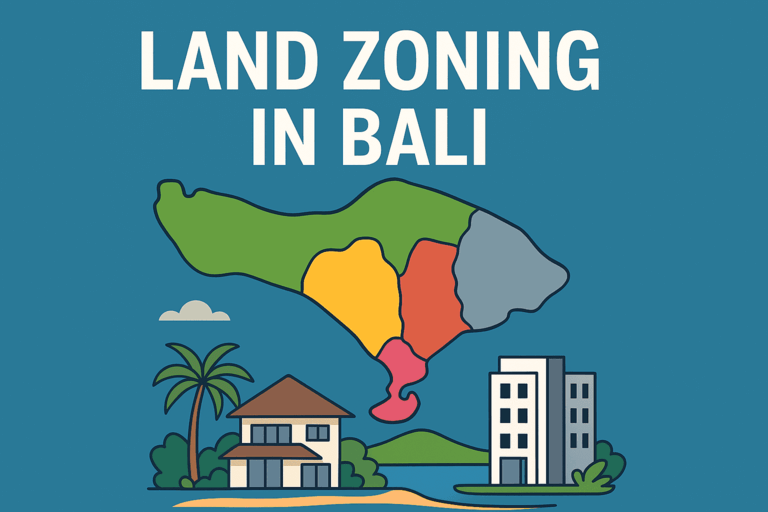
Imagine finding the perfect plot of land to build your dream villa in Bali. The location is strategic, the view is breathtaking, and the price seems attractive. However, as soon as construction begins, you receive an official warning: Your building violates zoning regulations. Cases like this are not uncommon in Bali, and many investors suffer losses for skipping this crucial step.
Zoning determines whether a piece of land can be developed into a villa, hotel, commercial property, or must be preserved as agricultural or conservation land. This is why it is essential for anyone looking to invest in property in Bali to fully understand the zoning system. In this article, you will learn about the different types of land zoning in Bali, from residential, tourism, and agricultural zones to conservation areas, along with the function of each. We will also explain how to legally verify the land’s status so you can avoid getting caught in a project that violates regulations and risks being demolished.
What is Land Zoning?
Land zoning is the classification of areas based on their function and designated land use, in accordance with the Spatial Planning Regulation (RTRW) set by the government. Zoning serves as the basis for issuing building permits (previously called IMB, now referred to as PBG) and determines the types of activities allowed on a particular piece of land.
Types of Land Zones in Bali
To fully understand the potential and limitations of a piece of land, you need to be familiar with the different types of land zones in Bali. Each zone has a specific function that regulates whether a property can be developed as a residence, a tourism-related business, or must be preserved as green space or conservation land. Below is a complete guide to the various land zoning types in Bali that you should understand before purchasing or investing in property.
Green Zone (Agriculture and Environment)
This zone is designated for agricultural activities, plantations, and environmental preservation. In this area, the construction of houses, villas, or tourism-related businesses is highly restricted or even completely prohibited.
The uses and restrictions for this zone include:
- Primary functions: agriculture, horticulture, rice fields, and plantations.
- Construction of houses, villas, or commercial properties is prohibited.
- Agricultural support buildings such as fertilizer storage or tool sheds may be constructed with special permits.
- Strictly regulated to protect the ecosystem and the Subak irrigation system, which has been recognized by UNESCO.
- Example locations: Jatiluwih, northern Ubud, and areas around Mount Batur.
Important note: Unauthorized construction in this zone is still quite common. If it does not comply with the regulations, the building may be demolished by the government.
Yellow Zone (Residential Area)
This zone is the most suitable for building private homes or personal villas. In some locations, rental properties are allowed, provided they comply with local permits and regulations.
The uses and restrictions for this zone include:
- Suitable for Building Rights (Hak Guna Bangunan), Lease Rights (Hak Sewa), and Use Rights (Hak Pakai).
- Permitted for the construction of private homes, villas, or small guesthouses.
- Development must comply with the density and building height limits set by the local government.
- Supporting infrastructure such as roads and drainage systems is already available.
- Some yellow zones may still be used for light agricultural activities.
Example locations: Denpasar, Sanur, Kerobokan, and most residential areas in Badung.
Read our complete guide to Yellow Zone zoning in Bali and its impact on property development.
Red Zone (Commercial and Trade)
This zone is designated for medium and large scale business activities. Properties in this zone are ideal for investors looking to develop businesses such as shops, restaurants, office buildings, or coworking spaces.
The uses and restrictions for this zone include:
- Intended for trade, service, and office activities.
- Complete infrastructure such as main roads, industrial grade electricity, municipal water supply (PDAM), and internet connectivity.
- Permitted to construct multi story buildings, subject to the maximum height limits set by the authorities.
- Suitable for foreign owned companies (PT PMA).
- Requires commercial permits such as a Business Identification Number (NIB) and a business location permit.
Example locations: Sunset Road, central Seminyak area, Jalan Raya Canggu, and Legian.
Pink Zone (Tourism)
This zone is intended for tourism activities and is one of the most sought after by foreign investors. In this zone, you can develop rental villas, resorts, hotels, beach clubs, or other tourism facilities.
The uses and restrictions for this zone include:
- Ideal for hospitality businesses such as daily rental villas, homestays, and hotels.
- Infrastructure is designed to support tourist comfort.
- Usually located near beaches, cultural areas, or nightlife districts.
- Must comply with aesthetic regulations and building height limits.
- Required to obtain a tourism business license from the local Tourism Office.
Example locations: Uluwatu, Pererenan, Berawa, Batu Bolong, and the southern part of Nusa Dua.
Orange Zone (Mixed Residential and Commercial)
This zone allows a combination of residential and business activities. For example, you can build a home with the ground floor used as a shop, cafe, or workspace.
The uses and restrictions for this zone include:
- Combination of residential buildings and business premises.
- Suitable for rental villas or private homes with small-scale businesses.
- Equipped with public infrastructure such as schools, hospitals, and markets.
- Requires dual permits for both business and building use.
- Can be built vertically with different floors serving different functions.
Example locations: Sempidi, central Canggu, and Jimbaran.
Conservation Zone (Nature and Cultural Preservation)
This zone is intended to protect Bali’s natural environment, biodiversity, and cultural heritage. The use of this area is highly restricted and it cannot be developed for commercial or residential purposes.
The uses and restrictions for this zone include:
- Includes protected forests, national parks, and cultural sites.
- No permanent construction is allowed without conservation permits.
- Permitted activities are limited to education, research, and eco-tourism.
- No public infrastructure is provided.
- Managed by government agencies or conservation organizations.
Example locations: West Bali National Park, Ubud Monkey Forest, and the Besakih Sacred Area.

How to Check Land Zoning in Bali
Before purchasing or leasing a property, it is essential to confirm the zoning status of the land. Here are several ways to check it:
GISTARU Interactive Map
This is the official website of the Ministry of Agrarian Affairs and Spatial Planning (ATR/BPN) that provides zoning information for all regions in Indonesia.
Link: https://gistaru.atrbpn.go.id/
The map displays zoning colors according to the Spatial Planning Regulation (RTRW) of each area.
BATARA Mobile App
Specifically for Android users, this application provides zoning data for the Badung Regency area.
Visit Government Offices
Go directly to the nearest Subdistrict Office, Spatial Planning Office, or BPN office to obtain official maps and zoning information.
Conclusion
Understanding land zoning in Bali is an essential first step before investing in or purchasing property, especially in 2026 when zoning enforcement continues to become stricter across the island. Each zone has its own characteristics, opportunities, and legal restrictions that determine what can be developed. Buying property without considering zoning functions can lead to serious losses, including building demolition or revocation of business permits. If you are looking for land, villas, or commercial properties in Bali, make sure to work with parties who truly understand zoning regulations and the legal process. At Bright Solution Property, we not only sell properties but also help ensure that your chosen investment is safe, legal, and aligned with your long term goals.


