 Bright Solution
 Market Trends
 June 30, 2026

Bali never stops moving.
Every mid-year, the Bali property market provides signals worth noting both for new foreign investors and experienced property owners on the island. June 2026 is no exception.
Following a solid post-pandemic tourism recovery, Bali has now entered a more mature phase: it is no longer just about recovery, but structured growth. Property demand is rising, new areas are emerging, and investors who move quickly with accurate data have a distinct advantage.
This article summarizes the key trends you need to understand in the Bali property market as of June 2026.
1. Villa Rental Demand Remains Strong, But Guest Selectivity is Increasing
One of the most noticeable trends in mid-2026 is the rising quality of demand not just the quantity.
Guests arriving in Bali today, particularly from the long-stay and bleisure (business + leisure) segments, are increasingly selective when choosing properties. They are not merely looking for a beautiful place to stay; they are seeking a complete experience: strategic locations, premium facilities, professional management, and excellent digital connectivity.
What does this mean for villa owners?
Professionally managed villas featuring structured operational standards, efficient booking systems, and consistent hospitality are proven to generate higher occupancy rates and a more competitive Average Daily Rate (ADR) compared to self-managed properties lacking a clear system.
This trend confirms that professional property management is no longer just an option it is the differentiating factor that determines profitability.
2. New Growth Areas: Beyond Seminyak and Canggu
For years, Seminyak and Canggu dominated property discussions in Bali. However, in 2026, the investment map is shifting.
Several areas showing significant growth include:
- Pererenan & Seseh: Still within reach of Canggu, but offering more competitive land prices and a quieter atmosphere. This area is attracting investors looking for value for money with medium-term appreciation potential.
- South Ubud (Tegalalang, Payangan): Demand for retreat properties, wellness villas, and eco-resorts continues to rise in line with global wellness tourism trends. Early investors in this segment are benefiting from relatively affordable land prices.
- Coastal Tabanan (Kerambitan, Selemadeg): This is an area gaining traction among knowledgeable investors. Improving access, uncrowded beaches, and significantly more affordable land make it a high-potential area for long-term investment.
- Nusa Penida: Ongoing infrastructure development makes Nusa Penida increasingly attractive. Enhanced fast-boat connectivity and planned tourism development are opening doors for boutique properties and eco-resorts.
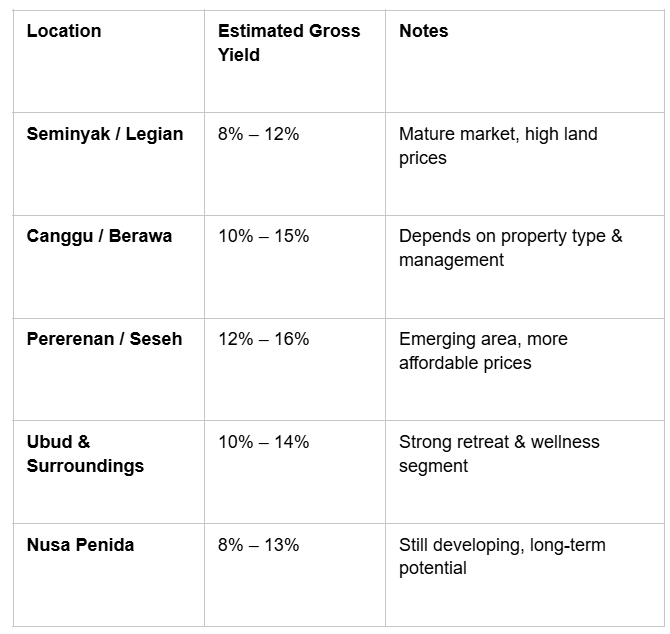
3. Bali Villa Yields: Realistic Figures in 2026
One of the most frequently asked questions by investors is: "What yield can I expect from a villa in Bali?"
The answer depends heavily on the location, management quality, and the targeted market segment. However, as a general rule, here is a realistic overview that can serve as a benchmark:
4. Crucial Regulations for Investors in 2026
The Bali property market cannot be separated from its regulatory framework. In 2026, there are several key factors investors must understand especially foreign investors:
- Proper Ownership Structure: Foreign investors cannot own property outright under Freehold (Hak Milik). However, recognized legal structures can be utilized lawfully, such as the Right to Build (Hak Guna Bangunan / HGB) through a Foreign Direct Investment Company (PT PMA). Understanding the nuances of these structures is critical before making investment decisions.
- Villa Business Licensing: Commercially rented properties require appropriate business licenses. Failing to meet these requirements is not only legally risky but can also impact the property's ability to operate and generate income.
- Tax Compliance: Income from villa rentals in Indonesia is subject to taxation. A solid understanding of tax obligations from the outset helps property owners project their cash flow accurately.
Proper legal and tax planning from day one is the foundation of a healthy and sustainable property investment in Bali.
5. Investor Trends: Who is Active in the Bali Market Today?
The profile of active investors in Bali in mid-2026 reveals interesting patterns:
- Australian & European Investors remain the largest segment, particularly for premium villas and lifestyle properties. They generally seek properties that can be professionally managed remotely with minimal direct involvement.
- East Asian Investors (especially from Singapore, Hong Kong, and South Korea) are showing increased interest, specifically in emerging areas with high appreciation potential.
- Domestic Investors are becoming more active, particularly those viewing Bali as a long-term investment destination with strong fundamentals.
One commonality across all these segments: they are increasingly informed and due-diligence oriented. They are not just buying property they are buying the certainty that their investment is managed properly, legally, and profitably.
6. Why Professional Property Management is Increasingly Relevant
In an increasingly competitive market, the quality of property management is a definitive differentiator.
Villa owners who partner with a professional property management team typically secure:
- More consistent occupancy rates due to structured marketing and distribution channels.
- More efficient operations with a dedicated team handling housekeeping, maintenance, and guest relations professionally.
- Maintained compliance including licensing, taxation, and regulatory reporting.
- Peace of mind especially for remote investors unable to monitor their properties directly.
This is not just about convenience it is about protecting your investment value.
Conclusion: Data is Your Advantage
The Bali property market in June 2026 offers tangible opportunities but it also requires a more structured, data-driven approach than ever before.
Investors and property owners who understand market trends, utilize the correct legal structures, and partner with trusted professionals are in a significantly stronger position to optimize their investment returns.
Bali remains one of the premier property investment destinations in Southeast Asia and with the right preparation, you can fully capitalize on these opportunities.
Discuss Your Property Needs With Us
Bright Solution assists investors and property owners in Bali with property management, legal compliance, and structured investment planning.
📞 Schedule a consultation with our team and discover the right solutions for your property needs in Bali.
👉 +62 831‑9997‑5969
The information in this article is educational and subject to change based on regulatory developments and market conditions.
Reference:
To support the claims and insights provided in the article above, here are the authoritative references outlining tourism trends, property regulations, and investment climates in Indonesia:
- Tourism Recovery & Demographics (Insight on Guest Selectivity & Occupancy)
Badan Pusat Statistik (BPS) Provinsi Bali - Official tourism arrival data, occupancy rates, and length of stay statistics. - Foreign Investment & PT PMA Regulations (Insight on Ownership & Legal Structures)
Ministry of Investment / BKPM (Badan Koordinasi Penanaman Modal) - Official guidelines on establishing a PT PMA (Foreign Investment Company) and HGB (Right to Build) regulations in Indonesia. - Property Tax Compliance & Business Licensing (Insight on Taxation)
- Direktorat Jenderal Pajak (DJP) - Official guidelines regarding property tax (PBB), income tax on rentals (PPh), and VAT (PPN) for commercial villas.
- Online Single Submission (OSS) System - Official platform for villa business licensing (NIB and standard certificates). - Global Wellness Tourism Trends (Insight on Ubud & Eco-Resort Growth)
Global Wellness Institute - Reports on the growth of the wellness tourism economy globally and in the Asia-Pacific region.


